One evening, my eyes were drawn to a bike in the shop’s pit for some reason. I walked over to check the brand, and deep within my chest, old memories were stirred.

I feel a distant memory that the breeze in Santa Cruz always had a faint scent of metal mixed in.
Deep in the mountains of that town, Rick Hunter had been working quietly for a long time, with only iron and fire as his companions.
His workshop wasn’t orderly. It wasn’t, but tools were always scattered in convenient places, and old MTB frames and samples hung from the walls.
The grinder would wail, and the mill was always running. Sparks flew often, but he just kept working silently.
He spoke only what was necessary and never left an extra word behind.

“Rick Hunter doesn’t talk much. He is the type who weighs what is necessary against what is not, and only speaks after confirming it one more time.”
— “Santacruz California Vol.1” (Circles, 2021)
This short passage I wrote before encapsulates his entire personality.
A man who is careful, honest, and speaks more through his hands than his words.
At the same time, he was someone incredibly honest about “play.”

“Breakfast is great, too. And then we plot. Not work, but how to play.”
— “About Playing Hunter Cycles” (Circles, 2021)
To Rick Hunter, craftsmanship was an “extension of play.”
It wasn’t overly serious, but it certainly wasn’t careless either.
I believe his version of “play” held the joy of touching the world using one’s own hands and body.
Many people fell in love with that freedom, and I think that when I visited, I was captivated by that atmosphere as well.
Darren Larkin, the young man who learned under Hunter

A young man who worked beside Rick Hunter for a long time is Darren Larkin.
I believe he absorbed his “philosophy of work” firsthand while helping with welding at Hunter’s workshop for about two years.
When Rick said, “I like steel that’s easy to build with,” it wasn’t just a technical point—it meant an honest attitude between a person and their materials.

When Darren took those words to heart, I’m sure it was a quiet conviction.
The frames and forks he creates have no unnecessary vanity.
Light, reliable, and sincere.
They aren’t overly polished, yet they provide a certain peace of mind.
That might be a kind of “work temperature” inherited from Rick.

After going independent, Darren established his own workshop in Deep River, Connecticut, on the US East Coast, and began calling it Larkin Cycles.
He skillfully uses both TIG welding and fillet brazing, handling everything through to the powder coat finish himself.
Each of his products features a sensible design that naturally integrates into the lives of those who ride them.
He’s not an artist—he’s a craftsman.
I believe he is another builder of the type who speaks by “not speaking.”
The encounter with CRUST Bikes and the birth of the Cargo Fork
I think Darren started gaining attention once he began drafting for CRUST Bikes.
CRUST is a cult American brand that keeps turning the common sense of gravel and touring upside down.
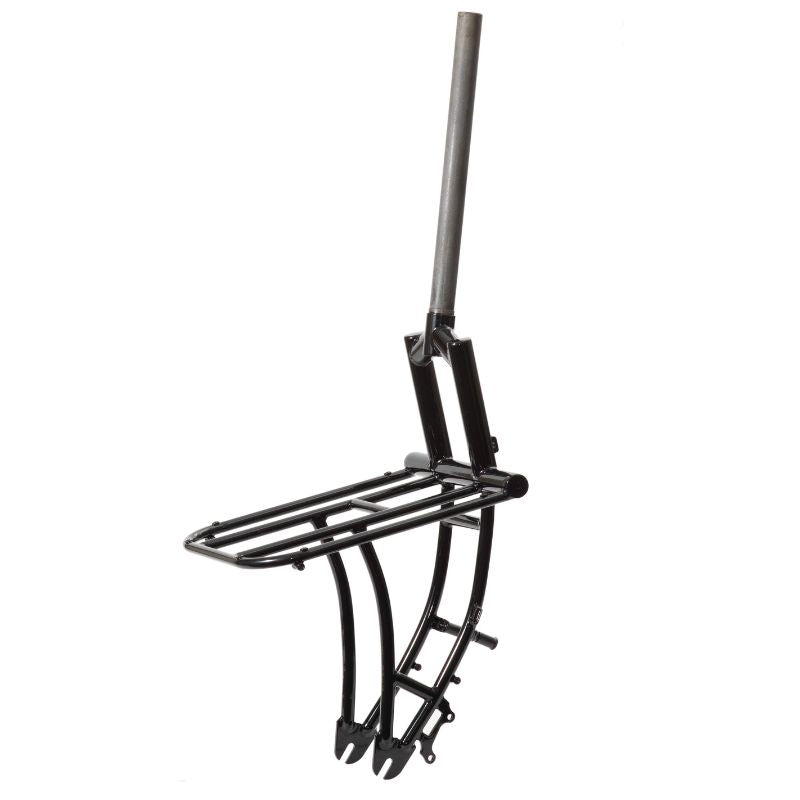
Among their offerings, I believe the Clydesdale Cargo Fork is one of his masterpieces.

At a glance, it looks like just a “fork for carrying luggage.”
But the structure requires incredible precision.
It adopts a 20-inch front wheel and features a platform integrated into the fork.
This low center of gravity design provides an astonishingly stable ride to even older bicycles.
If you install it on an old MTB or a bike that has lost its original fork, it instantly transforms into something like a small cycle truck.
The center of the rack is positioned over the hub axle, so the handling doesn’t become erratic even when loaded.
It features a practical design compatible with both V-brakes and disc brakes, including light mounts, fender bosses, and triple-bottle bosses.
Yet the shape is minimal. There isn’t a single flashy design element to be found.

I recall Rick’s words about “how to play.”
I am convinced that the fork designed by Darren is an extension of that very spirit.
While it is a “tool” for carrying heavy loads, it is simultaneously an “entrance to play.”
The idea of transforming a bicycle—or rather, a bicycle that had become difficult to use—into a “tool for living” is right there.

What Circles wants to deliver
The reason I especially want to introduce the Cargo Fork designed by Darren is not just because it’s convenient.
It is because I choose to believe it is a crystallization of the philosophy that began with Rick Hunter.
Because perhaps Darren is still trying to keep the atmosphere where Rick laughed amidst the sparks within his own hands.
And on that trajectory lies the CRUST Clydesdale Cargo Fork.

“It’s just play, after all. Or to put it another way, it’s just life.”
— “About Playing Hunter Cycles” (Circles, 2018)
When I re-read this line I wrote in my younger days, it helps me relax a little.
There’s no such thing as a “perfect product” from the start.
But “sincerely crafted tools” definitely change people’s lives.
This Cargo Fork might be the perfect example of that.
Whether loaded with camping gear or out for a grocery run in the city, it moves as naturally as if it were designed for that purpose from the beginning.
The small 20-inch tire supports heavy loads while spinning lightly.
Seeing that, I feel I can understand a little of what Hunter meant by “I like steel that’s easy to build with.”

Handling this fork is by no means an act of dwelling on the past; I feel it is about properly handing down the heat and laughter of that mountain workshop to the present day.
I feel the shadow of the master resides in every line Darren drew. Because I believe that the birth of such a cycle is the essence of Circles.
CRUST Clydesdale Cargo Fork is available at the Circles storefront and our online shop.
Our staff will be happy to assist you with installation or compatibility questions, so please feel free to ask.
I hope you can feel that the fork created by the hands of Hunter, Larkin, and CRUST is a “philosophy of play” being passed on.