
Seven’s Titanium Technology and Manufacturing Methodology | Final Installment
This is the final installment of our five-part series on Seven Cycles’ titanium technology and manufacturing methodology. Nothing would make us happier than knowing that through reading this, you have gained a deeper understanding of titanium as a material.
Continuing from the previous post, we will begin with "An Overview of Titanium Fabrication | Polygon Tubes."
About Polygon Tubes
Recently, we have been seeing more tubes that are geometrically shaped, such as oval, square, or hexagonal. Many such designs are marketed for their visual impact or "increased stiffness."
In reality, however, these polygon tubes are often inferior to round tubes in terms of performance.

Stiffness: Differences by Shape
A round tube provides the most even distribution of force against torsion and flex, making it the shape with the best balance of stiffness.
- Polygon tubes tend to be weak against torsion.
- While oval tubes may be strong in the vertical direction, their lateral and torsional stiffness are reduced.
Consequently, the fact remains that a round tube provides the most stable stiffness for a given weight.
Impact on Grain Structure
Titanium’s "grain structure" refers to the arrangement of metal crystals. This significantly influences strength and toughness.
However, forcibly altering the tube shape can disrupt this grain structure, posing a risk of compromising fatigue strength and stiffness.

Notch Sensitivity and Reliability
Many polygon tubes are formed using a mandrel, which can create minute scratches on the inner surface during the process. This leads to "stress concentration" and can become a cause of failure.
In other words, polygon tubes are only effective when there is a clear intention and reason; avoiding round tubes purely for appearance or trends is counterproductive.
Of course, there are cases where multi-shaped tubes can be useful, but the use of such tubes should stem from a clear purpose. It is true that avoiding round tubes without reason—thereby compromising basic performance—is counterproductive, and I hope you find the following table useful, which details the strengths and weaknesses of polygon tubes when categorized into three types.

Surface Finishing Technology
Anodizing
Anodizing, which creates an oxide film with beautiful colors, is attractive for decorative purposes. However, it is also a highly unsuitable process for titanium frames.
- The oxide film is brittle and causes weld degradation.
- There is a risk that cracks will spread from the surface to the interior.
- It prevents further bending processes and significantly impairs strength.
Seven strictly prohibits anodizing. Our policy is that frames treated with this process will no longer be covered by our lifetime warranty.
Shot Peening
Shot peening is a process of firing tiny metal spheres at high speed to impart stress on the surface. This creates a compressive stress layer on the tube surface, which can help suppress crack initiation.
However, for thin and complex structures like bicycles,
- It is extremely difficult to perform at the correct impact angle (90 degrees).
- In reality, many spheres strike at an angle, merely leaving scratches on the surface.
Because of this, achieving practical benefits is currently difficult.
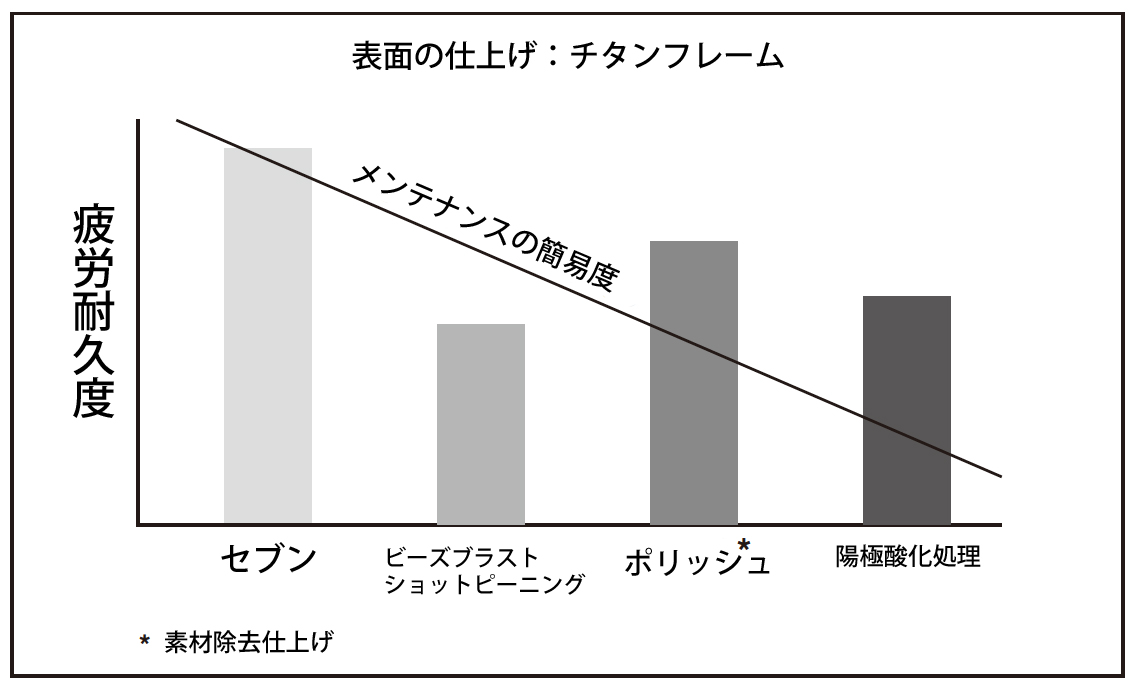
Polishing (Mirror Finish)
While a high-polished titanium frame is beautiful,
- It is difficult to control the amount of metal removed during processing.
- Weld points are particularly prone to reduced strength.
For these reasons, Seven does not use it.
The satin finish we provide instead is:
- Easy to maintain.
- Possible to maintain yourself using Scotch-Brite™ (Very Fine) for any scratches incurred during use.
It is a finish that achieves both appearance and practicality.

Welding Technology | The Essence of Seven
Titanium is an extremely delicate metal, and its strength decreases significantly if it reacts with oxygen, nitrogen, or hydrocarbons during welding. Therefore, Seven has standardized highly advanced processes:
- Thorough cleaning and degreasing before welding
- Welders are required to wear cotton gloves
- Use of our own custom-improved TIG welding torches and lenses
- Inert gas filling inside the frame using a positive-pressure purge system
Furthermore, by protecting both the inside and outside of the frame with inert gas, we completely prevent the molten metal from oxidizing or nitriding.


Finishing Work
Finishing the frame takes approximately one full day.
- Removal of residues and oils
- Final polishing with nylon wheels (*not a mirror polish)
- Smoothing with Scotch-Brite™ (Grade A, Very Fine)
- Spray coating with a special wax (to protect against fingerprints and oil stains)
And finally:
- Water bottle mounts
- Laser-cut stainless steel head badge
- Installation of seat tops and hardware
- Laminated card signed by everyone involved in the production (includes geometry and serial number)
With this, your one-and-only, unique Seven frame is complete.
Final Thoughts
For over 25 years, Seven Cycles has been sincerely dedicated to titanium frames, continuing to evolve and take on new challenges. We hope that through this series, you have been able to get a glimpse of the philosophy and technology Seven uses to craft its bicycles.
Perhaps it is time for you to build your own Seven.
